This was supposed to be research.Then it became a business.
I wanted to understand print on demand so I could give clients useful advice from actual experience. Somewhere between the first design and the shipping profiles, I ended up with a brand, a Shopify store, and an Etsy shop. Apparently, I don’t do casual research.
Business
Forgot To Press Send · Owned by Wannawow
Industry
Original gifts & everyday goods
Work
Brand, products & ecommerce
Channels
Shopify & Etsy · Live
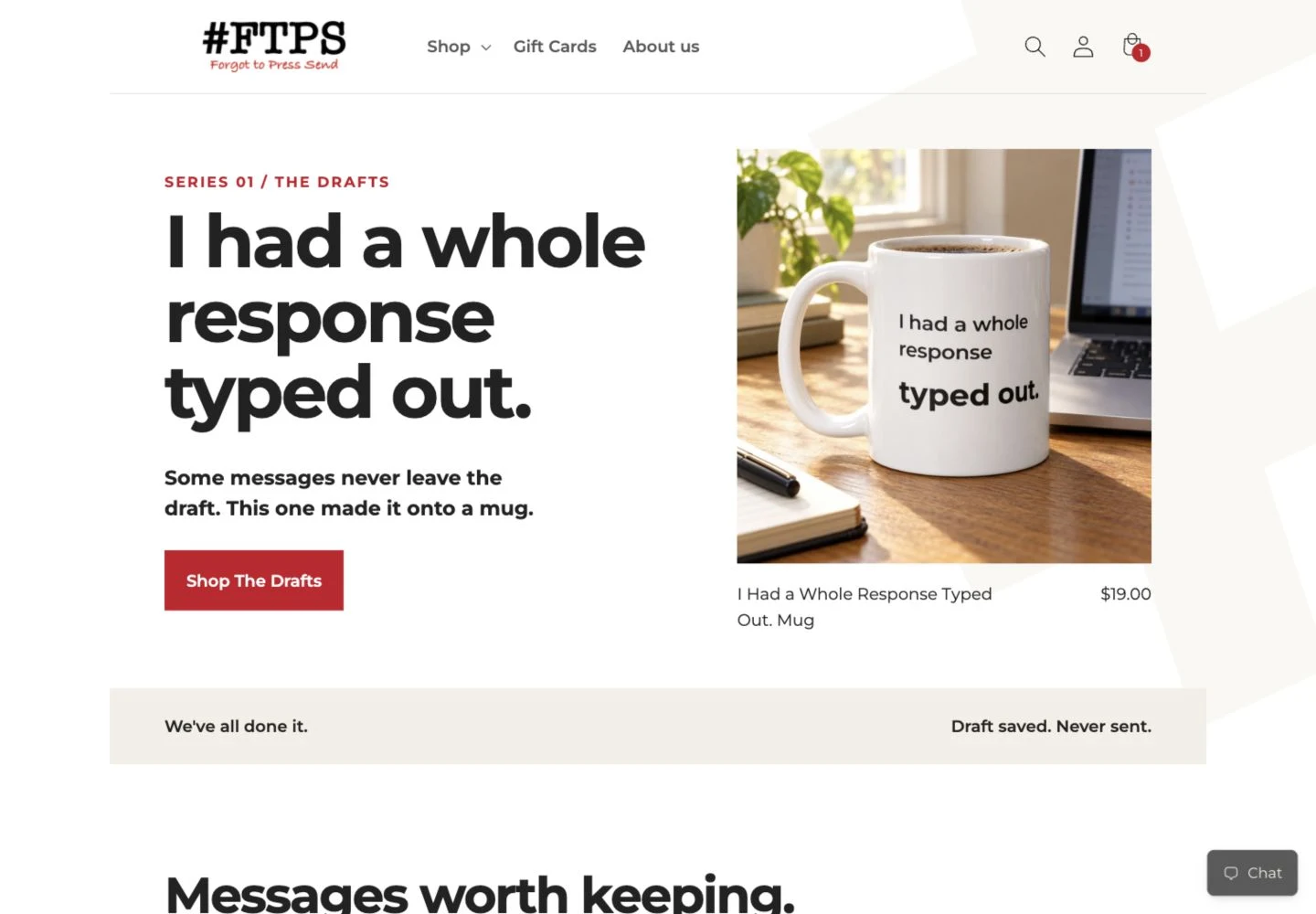
The Shopify storefront gives the brand its own home. Screenshots in this case study were captured in October 2026.
Why I started
I should probably try this myself.
It’s easy to like the idea of print on demand: create a design, put it on a product, sell it without filling the spare room with boxes. I wanted to understand what happens after that very appealing sentence.
Which products make sense? Does the artwork work on the actual item? What happens to the margin once shipping and fees join the conversation? Those are the questions I wanted to work through before helping clients make the same decisions.
That exploration became Forgot To Press Send, a business owned and operated by Wannawow, LLC. The learning exercise now has a product catalog and customer service responsibilities. I may have taken the assignment a little further than necessary.
The creative idea
A little snark. A lot of thought.
FTPS inherited a fair amount of my personality. The overthought reply. The pointed silence. The last word I probably should have kept to myself. It turns out those things fit quite nicely on a mug.
The humor comes from recognition. You’ve typed that reply. You may even have had the good judgment to delete it. Understated typography, generous space, and a small red #FTPS signature give the words room to land.
The Drafts, Left on Read, and The Last Word each explore a different part of the conversation. #FTPS Essentials carries the brand itself. The messages appear on mugs, notebooks, shirts, hoodies, stickers, and magnets.
The attitude is deliberate, and so is the design. A line that reads well on a notebook can feel completely different wrapped around a mug. Placement, line breaks, scale, and series signatures all get reviewed for the actual product.
What went into it
The fun part. And everything that makes it work.
The things customers see
Original message collections and coordinated product artwork.
A customized Shopify storefront with series navigation and product-specific content.
Product views, lifestyle imagery, and selected product videos.
An Etsy shop with consistent branding and a curated assortment.
The things that had better work
Printful product setup, print-file checks, and variant mapping.
Channel-specific pricing, shipping profiles, and product information.
Branded customer notifications and marketing automations.
Repeatable product-launch checks and documented operating workflows.
A home for the brand
The store should have a personality, too.
The Shopify store builds on the Spotlight theme, with custom layouts and styling that carry FTPS from the homepage into collections and product pages. Series labels and previous/next links help customers follow a thought through the collection.
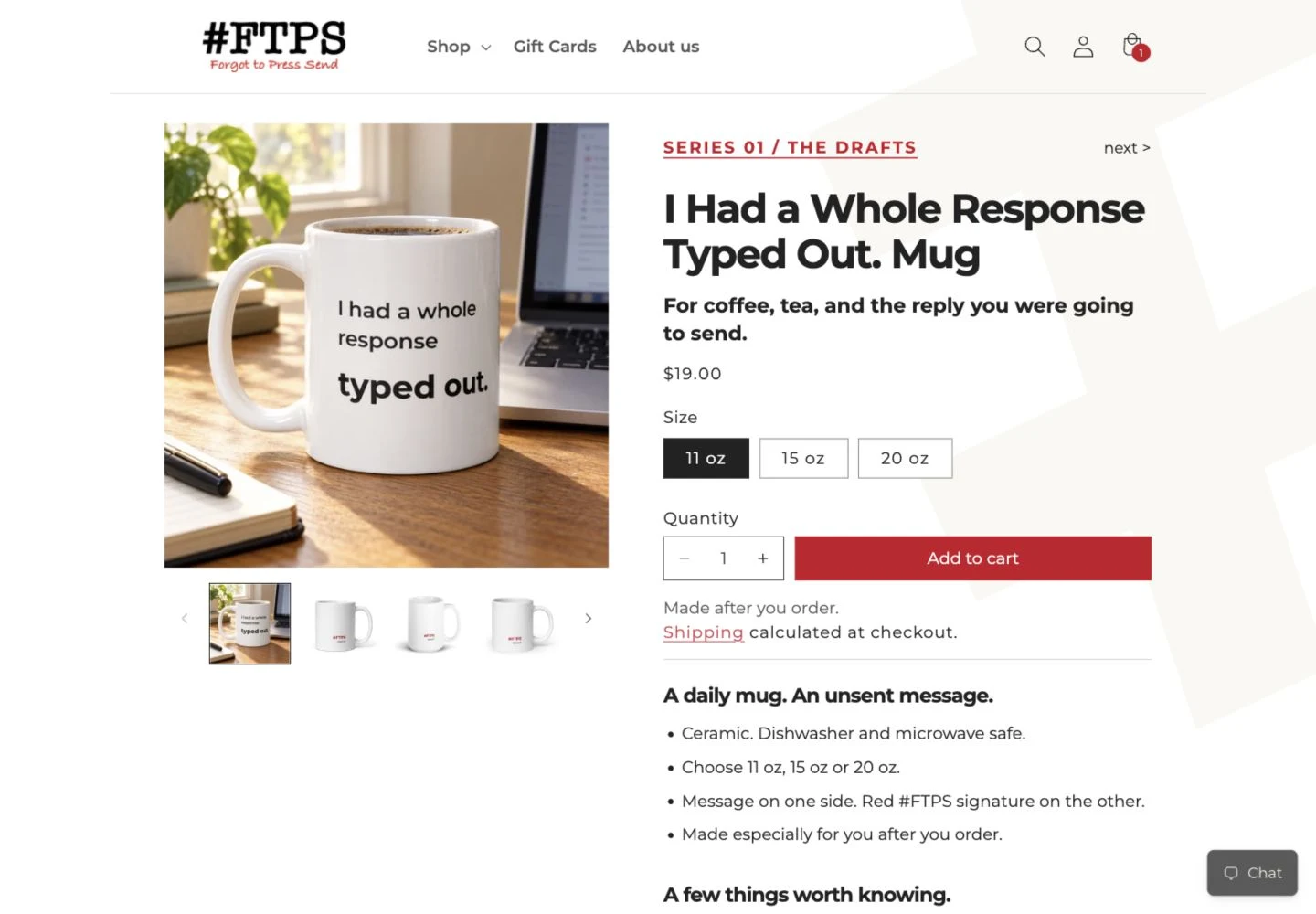
The copy can have an attitude. The size selector should be straightforward. Product pages bring together the message, available sizes, materials, FAQs, and made-to-order shipping notes so people can make an informed choice.
Shared series templates keep the presentation consistent, with product-specific content editable in Shopify. Lifestyle scenes show the products in use; supporting views show the artwork and physical details. Selected videos carry that presentation across Shopify and Etsy.
And yes, it all gets reviewed on a phone. That’s where a generous desktop layout tends to reveal its less generous habits.
A product page brings the message, imagery, options, and practical buying information into one view.
Beyond the storefront
Snark on the mug. Clarity everywhere else.
I create the original messages and artwork. Printful prints, packs, and ships the made-to-order products. Each sellable size and color needs to point to the right product and print file. A clever line loses some of its charm if the wrong thing arrives.
The less photogenic work includes category-specific shipping, channel-specific costs, and policies that reflect how production works. Supplier costs, shipping, and platform fees all get a say in the selling price. They tend to be very committed to the discussion.
Branded order and shipping notifications, gift-card emails, email signup, and marketing automations carry the experience beyond the product page. The voice stays familiar, while delivery information and support stay clear. Customers shouldn’t have to interpret a joke to find out what happens next.
A second sales channel
Naturally, one storefront became two.
Adding Etsy meant working through a different shopping experience: which products to lead with, what buyers might search for, and whether the images still made sense when reduced to a marketplace thumbnail.
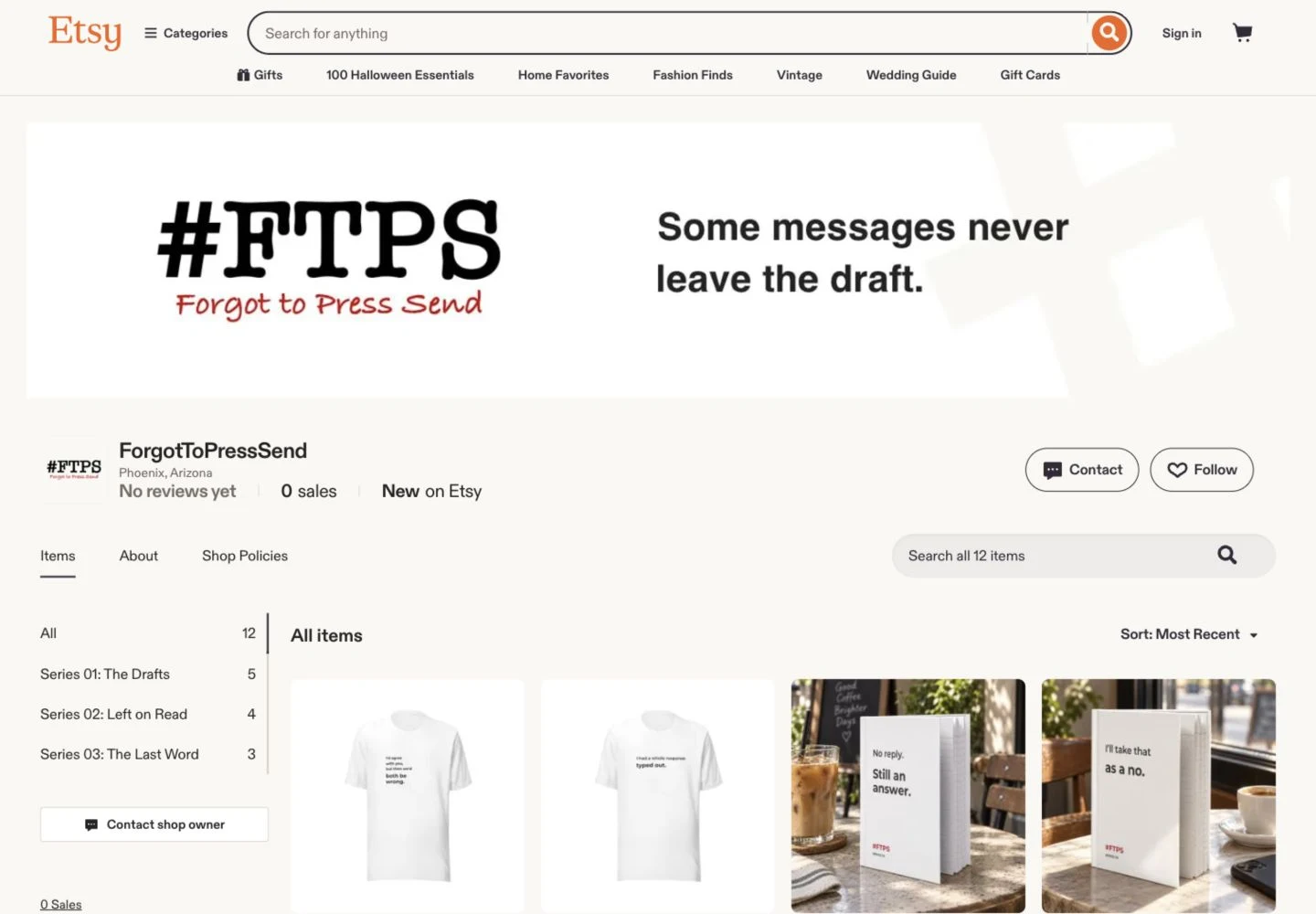
The shop launched with a curated selection of mugs, notebooks, and shirts. The banner, story, and collection sections carry the FTPS identity, while titles, tags, attributes, and descriptions are shaped for Etsy. Native keyword research helped inform the listings. Snark still needs to be findable.
Product galleries, size guides, selected videos, shipping profiles, production-partner disclosures, and shop policies complete the listings. The brand stays recognizable across both channels; each platform still has its own details to get right.
The Etsy shop carries the same identity into a marketplace, with its own assortment, listing structure, and image requirements.
What carries into client work
Useful advice comes with a few shipping profiles.
Running my own brand makes the connection between the website and the business very clear. A theme change affects how a product is understood. A variant mapping affects what gets made. A shipping rule affects checkout and the margin.
It has also given me a repeatable way to launch products: establish the message, adapt the artwork, prepare the listings, verify production mappings, review the shopping experience, and publish the approved set. I document the process because “I’m sure I’ll remember how I did that” has a fairly poor track record.
That experience carries directly into Wannawow’s client work. Whether you’re testing a first collection, improving a Shopify store, or adding another sales channel, I can help you work through the practical decisions with firsthand experience behind the advice.
Live & evolving
The research now has its own checkout.
Forgot To Press Send now has an original product range, a Shopify home, an Etsy shop, and the workflows behind both. I’m still developing the brand, adding products, and improving how it all works. What started as a way to help clients became a business I get to build for myself. With somewhere to put the replies I wisely didn’t send.
A first POD collection, a store that needs some attention, or a promising idea that has outgrown the notes app. Tell me what you’re thinking, and we’ll work through the practical next step.